
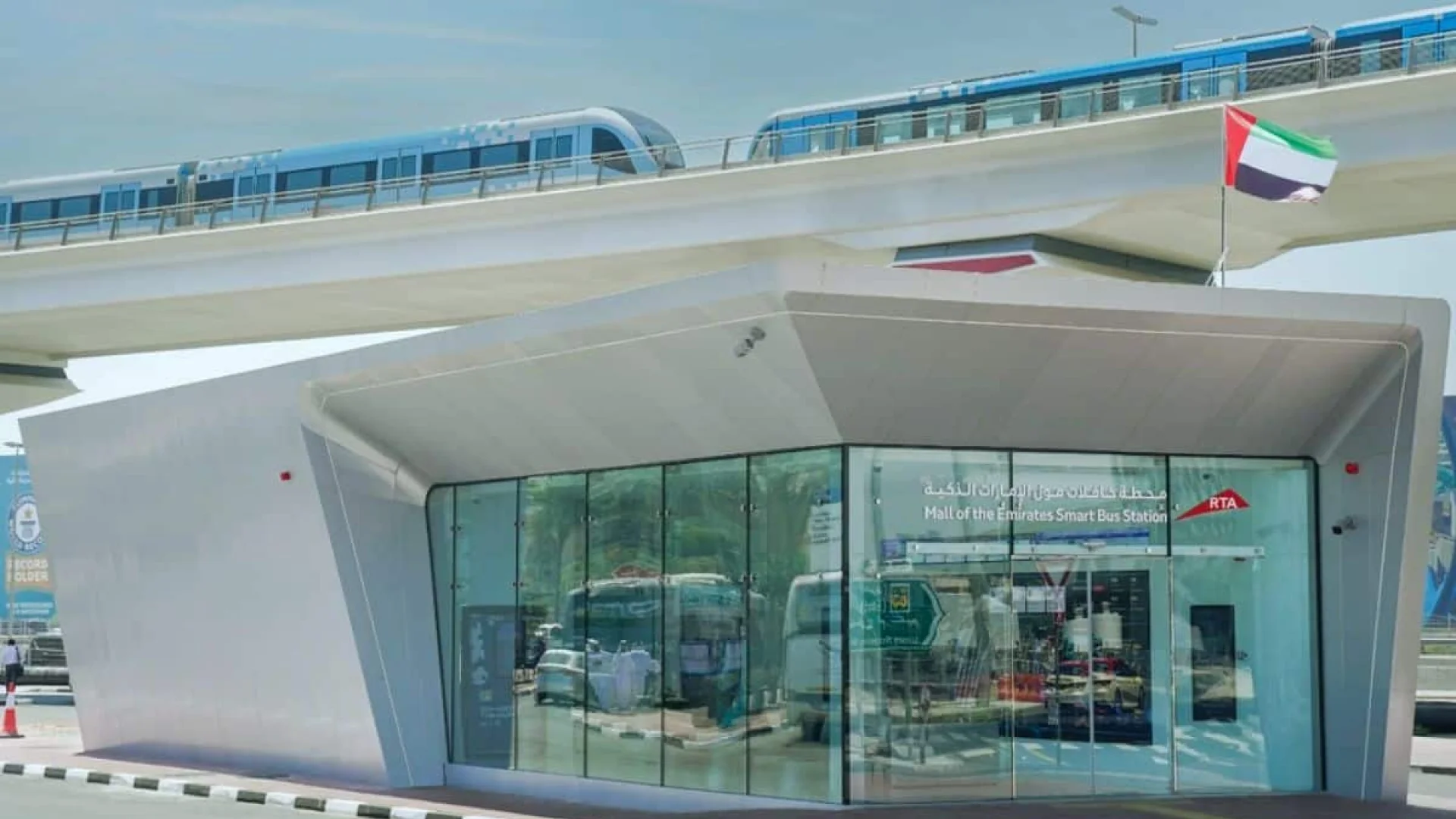

At Mall of the Emirates, Dubai has unveiled its first smart bus station—an air-conditioned, tech-enabled shelter designed to make public transport feel effortless in a city where summer heat can punish every minute outdoors. Introduced by the RTA, the new station pairs comfort with real-time, digital information to help riders plan trips and reduce the uncertainty of waiting. It’s a showcase for how Dubai wants daily mobility to look: cleaner, smoother, and more inviting for commuters, shoppers, and visitors alike. And it signals a wider push to upgrade bus infrastructure as part of the city’s ongoing transport modernization.
The sidewalk outside Mall of the Emirates has its own soundtrack: suitcase wheels ticking over paving joints, taxi doors thudding shut, a soft electronic beep as a bus kneels to the curb. Then the heat arrives—thick, bright, unapologetic—wrapping itself around everyone who dares to pause.
And yet, right there by the road, something new glints like a small piece of science fiction that took a wrong turn and landed in Al Barsha. A compact, sleek capsule. A place to wait that doesn’t feel like waiting.
“Is this the new one?” a shopper asks, hovering at the entrance with a bag swinging from his wrist. He steps inside and his shoulders drop instantly, as if someone turned down the volume of the city.
Dubai’s Roads and Transport Authority (RTA) has opened the city’s first smart bus station at Mall of the Emirates. The headline sounds like a simple infrastructure update—new shelter, new screens, move along. But standing here, feeling cool air on your skin while traffic shimmers outside, you realize it’s something more ambitious: a re-design of the most fragile part of public transport—the moment before the ride even begins.
In many cities, a bus stop is a compromise: a thin roof, a narrow bench, a prayer that the next bus is close. In Dubai, where much of daily life happens in climate-controlled spaces—cars, offices, malls, towers—stepping outside can feel like leaving the modern world behind for a few brutal minutes.
This is the gap the smart bus station tries to close. It’s air-conditioned, designed for comfort, and built to make the curb feel less like an endurance test. The idea is straightforward and quietly radical: if Dubai wants more people to choose buses, the experience has to be pleasant from the first second, not only once you’ve found a seat.
The location is not accidental. Mall of the Emirates is a daily crossroads—tourists drifting from hotels, staff commuting from nearby neighborhoods, families who have just spent hours under the mall’s perfect indoor weather. Put the first smart station here and you’re placing it in front of everyone: residents, visitors, skeptics, converts.
There is a particular kind of anxiety that comes with waiting for a bus in the heat: How long will this take? Ten minutes can feel like a small punishment; forty feels like a bad decision. The smart bus station leans on digital services and passenger information to remove that uncertainty—helping riders anticipate arrivals and plan connections.
It’s not about turning a bus stop into a gadget showroom. It’s about treating information as comfort. When you can see what’s coming, time behaves differently. Waiting becomes a pause you can manage, not a void you suffer through.
You can feel the shift in people’s posture. A commuter glances at the display, nods once, and stops pacing. Two teenagers take a quick photo, as if to say: Dubai really did it again. A tired employee in a slightly rumpled shirt steps inside, exhales, and mutters—barely audible—“Finally.”
If you want to change habits, you start where habits are strongest. Around Mall of the Emirates, mobility is constant: metro users surf the crowds, buses arrive and depart in steady rhythm, taxis glide in dedicated lanes. The area is a living map of Dubai’s daily movement—work, leisure, errands, tourism.
By placing the first smart bus station here, the RTA is doing two things at once:
It’s a subtle cultural statement. A city that prizes seamless service is applying that logic to the curb.
Dubai’s transport story has always been about scale—new roads, new rail, bold timelines. But the everyday friction points matter just as much as mega-projects. A hot, confusing bus stop is friction. A cool, legible, comfortable one is an invitation.
The smart station fits into a broader modernization push: upgrading public transport assets, improving rider experience, and making the system feel contemporary. It’s hard to convince drivers to leave their cars if the alternative feels uncertain or physically uncomfortable. But make the waiting cleaner, cooler, and easier to understand—and the math starts to change.
In a city with heavy footfall and intense climate swings, the waiting environment is not decoration. It’s infrastructure.
The new station is designed to combine comfort with practical technology. You don’t need to know the engineering details to understand the impact. You step in, you cool down, you get information. The rest of the city can keep blazing outside.
It’s the kind of improvement that looks modest on paper and feels enormous in real life—especially when the sun is at its most relentless and you’re carrying bags, wrangling kids, or racing a work clock.
Watch the scene for five minutes and you see why this matters. People don’t just pass through. They linger—because now they can. A brief chat starts between strangers comparing routes. A visitor points at the station and asks, “So the bus is air-conditioned too?” The answer, in Dubai, is almost always yes. But the station makes the whole journey feel consistent: comfort doesn’t begin at the mall entrance; it begins at the stop.
Dubai is, in many ways, a city of transitions: from car to metro, from street to mall, from heat to cool. The first smart bus station is a small architectural promise that those transitions can be smoother.
Outside, traffic continues to slide past in shimmering lines. Inside, the air holds steady. The waiting becomes ordinary. And that, in a city built on big gestures, may be the most powerful thing of all.
Transport upgrades like this rarely stay confined to “mobility news.” For real estate investors, they are location signals—especially in Dubai, where accessibility, comfort, and perceived convenience directly influence tenant choice and, ultimately, pricing power.
1) The rise of “transit quality” as a pricing factor: Proximity to a metro station has long been a valuation shorthand. The next layer is the quality of the first and last mile: shaded or air-conditioned waiting, clear information, safe pedestrian paths, and a sense that the system is reliable. A smart, air-conditioned bus station improves that chain, making public transport a more realistic daily option for a broader tenant pool.
2) Immediate micro-location uplift around Mall of the Emirates / Al Barsha: The Mall of the Emirates district is already an established node with hotels, offices, residential towers, and serviced apartments. Enhancing the bus interface at this hub strengthens its role as a multi-modal anchor. For landlords, that can translate into:
3) Demand support for car-light living: While Dubai remains car-friendly, the market is gradually widening for tenants who prefer fewer car trips—especially younger professionals, cost-conscious households, and short-stay residents. Better bus-stop infrastructure lowers the psychological barrier to using buses for quick hops between neighborhoods, malls, and metro connections.
4) A roadmap clue for future roll-outs: If this station is a pilot that scales, investors can track where similar upgrades appear next—high-footfall corridors, dense residential pockets, and commercial clusters. Those areas may experience incremental demand uplift because mobility becomes more comfortable year-round. In practical underwriting, that can mean tighter vacancy assumptions and improved rent resilience.
5) ESG narrative and institutional appetite: Improved public transport usability supports sustainability positioning for assets and portfolios. For institutional capital, mobility-oriented improvements can strengthen an ESG storyline—not as abstract policy, but as tangible infrastructure that helps reduce car dependency.
Investor takeaway: When evaluating assets near major nodes like Mall of the Emirates, look beyond distance-to-transit. Assess the user experience of the connection—especially in extreme weather. Where the city invests in comfort and information at transit touchpoints, the surrounding real estate often benefits from higher perceived livability and smoother daily routines, both of which can support long-term demand.