
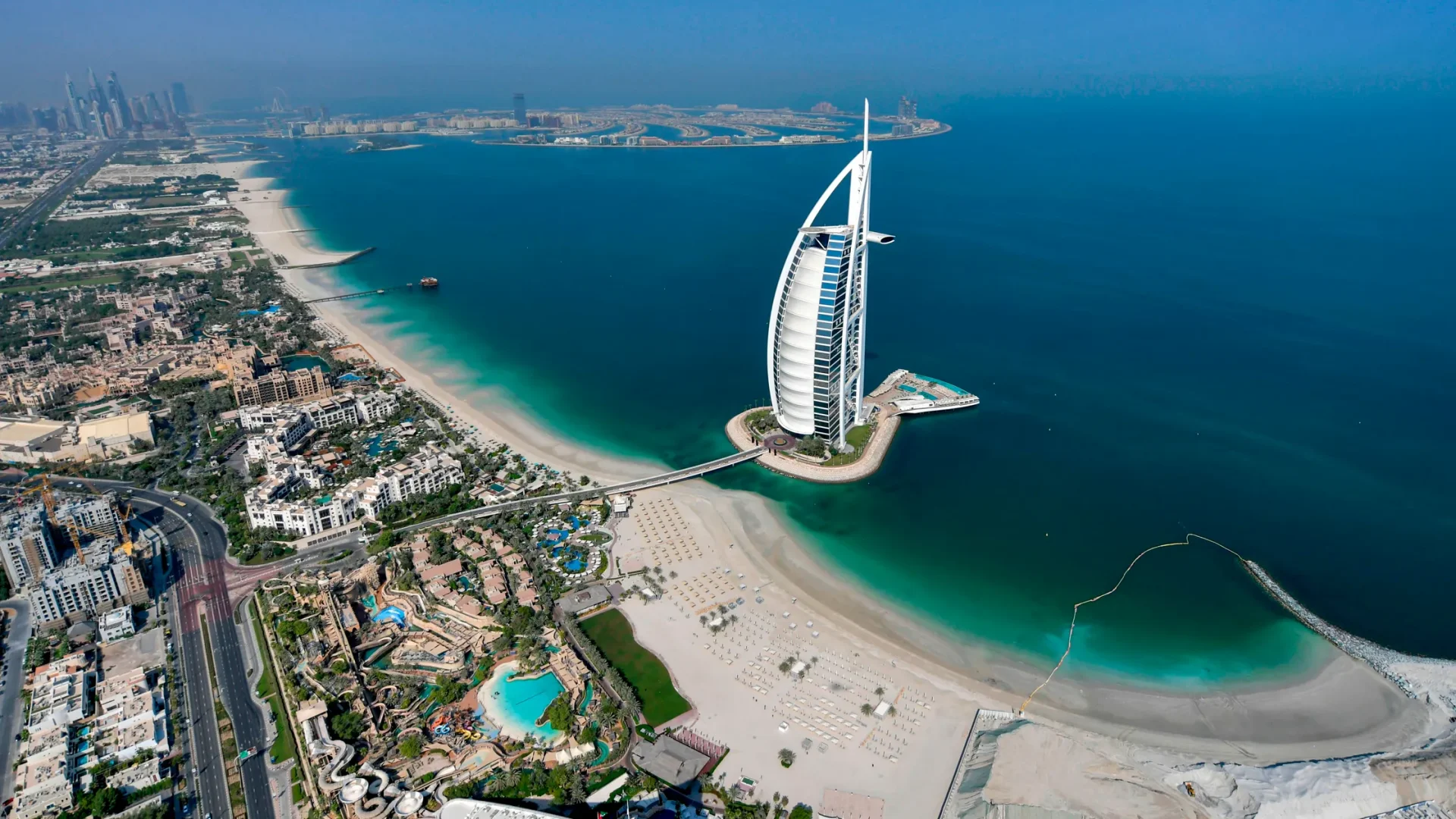
The sun hits the Burj Khalifa like a flashbulb, and suddenly the entire promenade lifts its phones in unison: Dubai has been named the world’s most Instagrammable city. From the Palm Jumeirah’s unmistakable outline to the Museum of the Future’s sci‑fi curve, the city concentrates globally recognizable backdrops into a tight, walkable itinerary. The ranking underlines what Dubai has perfected—turning architecture into experience and experience into worldwide visibility. For tourism brands and real estate investors alike, that visibility is not just vanity; it’s demand, occupancy, and pricing power in the right locations.
The first thing you hear is the clicking.
Not the polite, occasional click of a tourist camera—this is a steady, glittering rhythm. A thousand small shutters firing at once. The air is warm, the stone underfoot still holding yesterday’s heat, and a thin line of sunlight starts to slide down the Burj Khalifa as if someone is slowly unzipping the sky.
“Wait—now,” a woman whispers to her friend, and both of them tilt their phones up. The tower answers with a perfect gleam. Downtown Dubai, for a few seconds, becomes a single shared instinct: capture it.
Dubai has been named the world’s most Instagrammable city, according to a widely cited report highlighted by Arabian Business. The headline sounds playful—something born in a scroll—but it points to a serious reality: few places on earth generate so many globally recognizable images per square kilometer. This is a city that doesn’t simply have landmarks. It has icons, engineered for instant recognition and repeat sharing.
And once you see the choreography up close, the title feels less like an award and more like a description. People aren’t just sightseeing; they are storyboarding. Angles are tested. Poses rehearsed. A couple steps aside to avoid a stroller in the frame. “One more,” he says, patient, as if the city will hold its light a second longer for them.
Instagrammability is a strange mix of art and math. It’s not only beauty; it’s clarity. A skyline that reads instantly. A silhouette you can recognize even when it’s tiny on a screen. Dubai’s built environment is full of that kind of visual shorthand—bold shapes, clean lines, dramatic contrasts between desert tones and mirrored glass.
The Burj Khalifa plays the starring role, of course: the world’s tallest building is an easy subject and a hard one to resist. But the supporting cast is just as potent. The Palm Jumeirah is not merely an island; it’s a symbol you can identify from an airplane window. The Museum of the Future looks like it arrived from a different decade, planted on Sheikh Zayed Road with the confidence of a sculpture that knows it will be photographed.
In other destinations, marketing arrives as a campaign. In Dubai, it arrives as a habit. Every photo posted is a tiny advertisement—unpaid, enthusiastic, and persuasive precisely because it looks personal. The result is a self-reinforcing flywheel: visibility fuels curiosity, curiosity fuels arrivals, and arrivals fuel more visibility.
Walk along the promenade near Dubai Mall and you can feel it. The languages change every few steps—Spanish, Russian, Hindi, French—yet the behavior stays the same. People point. People smile. People step back until the whole tower fits into the frame. The city doesn’t need to explain itself; it shows itself, loudly.
“We only have two nights,” a young traveler says, breathless, eyes still on the skyline, “but we had to come here.” The word “had” hangs there. Dubai has become a must-do image, a modern stamp in a digital passport.
Dubai’s secret isn’t simply that it built big—it built memorable. Landmarks here are designed like stages, with built-in drama: reflective surfaces that catch the sun, water features that add movement, wide boulevards that create reveal moments as you turn a corner. Even the transitions—bridges, promenades, viewpoints—often feel like they were drawn with a camera in mind.
A taxi driver, threading traffic on Sheikh Zayed Road, nods toward the Museum of the Future. “Every day, people stop,” he says. “Always photos.” He doesn’t sound amused, just factual—like he’s describing the wind.
The surprising thing is how much remains. Behind the photogenic surfaces, Dubai runs on infrastructure: hotels that absorb waves of arrivals, transport networks that keep the city legible, a hospitality scene that knows how to deliver a ‘wow’ without collapsing under its own popularity.
At night in Dubai Marina, the water becomes a dark mirror. Towers stretch down into it, trembling with light. A child points at a passing yacht. “That one!” he says, and his mother laughs. Nobody is posing now. Yet the moment still feels composed, cinematic—Dubai’s default setting.
Being the world’s most Instagrammable city is not a trivial badge. It reflects a shift in how cities compete. Airports, ports, financial districts—these still matter. But so does instant, global visibility. A skyline that travels faster than any brochure. A landmark that becomes a shorthand for ambition, luxury, possibility.
Dubai has learned to speak in images: desert and glass, heritage and hyper-modernity, beach and boulevard. It’s easy to understand in one second, and that’s exactly why it spreads worldwide.
For investors, “most Instagrammable” is not a lifestyle footnote—it’s a demand signal. In a city where visibility constantly drives arrivals, the link between social media presence and real estate performance can be direct: higher tourism volumes support hotel metrics, short-stay demand, retail footfall, and—by extension—rents and yields in the right micro-locations.
1) Landmark adjacency can translate into pricing power: Districts anchored by globally photographed icons—Downtown Dubai (Burj Khalifa/Dubai Mall), Dubai Marina/JBR, Palm Jumeirah, parts of Business Bay—benefit from brand spillover. “Burj view,” “Marina view,” “steps from the fountains” aren’t just brochure lines; they are conversion triggers for travelers and tenants who came with a picture in mind.
2) Short-term rentals and serviced living: Instagram-driven travel behavior tends to favor flexible stays and experience-led itineraries. Professionally managed holiday homes, serviced apartments, and branded residences can capture that demand—provided investors underwrite realistically: licensing rules, seasonality, management fees, service charges, and competitive supply all shape net returns.
3) Mixed-use assets ride the attention wave: Where people gather for photos, they also spend money. F&B terraces with skyline views, cafés positioned on promenade traffic, and retail units near “must-see” nodes often see stronger footfall. Mixed-use projects can benefit from multiple reinforcing revenue streams when the surrounding area remains a social-media magnet.
4) Micro-location matters more than ever: In Dubai, two units in the same tower can trade at meaningfully different price points depending on view corridors, floor height, balcony orientation, and whether a sightline is protected from future development. In a city built on images, an unobstructed view is not just pleasant—it can be monetizable scarcity.
5) Supply pipelines and differentiation: A global branding boost doesn’t eliminate market cycles. Investors should still stress-test assumptions against upcoming completions, developer quality, operating costs, resale liquidity, and tenant mix. The most resilient assets tend to combine location with genuine differentiation—unique views, direct waterfront access, or walkable proximity to the city’s most shared landmarks.
Investor takeaway: Treat social-media gravity as an additional layer in location analysis. In Dubai, “photographable” can function like infrastructure—a soft asset that steadily converts attention into occupancy, and occupancy into cash flow.